Born Again Christian Bill Williams St. Louis Mo
Evangelicalism and Politics
John Fea, Laura Gifford, R. Marie Griffith, and Lerone A. Martin
In 2022 Donald J. Trump won the presidential election with overwhelming Christian evangelical back up. Commentators and pundits have struggled to explain how a president who seems to scorn traditional Christian values—as axiomatic in his rumored affairs, his divorces, and his alleged sexual assaults and harassment—has garnered the devotion of a bulk of evangelicals. The American Historian asked four historians of faith and politics for their analysis of evangelicals' analogousness for Trump and of their commitment to the bourgeois movement more than broadly.
one. Recently, historians have produced a "cottage industry" by writing extensively about the Religious Right and the role of evangelicals in mobilizing the Republican party of Ronald Reagan and George W. Bush. What critical turns and animating factors led to evangelicals' enlistment in the modern Republican Right? When, in your estimation, did evangelicalism transform itself into such a potent political movement?
Lerone Martin:
Evangelicalism has been a significant strength in American politics since at to the lowest degree the nineteenth century. Withal, the direction of this political force, likewise as the media and scholarly attending it receives, has ebbed and flowed. In recent history, several disquisitional turns and factors have led the overwhelming majority of white evangelicals to motion towards the modern Republican party. One cistron in this shift was the modernistic civil rights era and the black freedom struggle. The Dark-brown v. Board Supreme Court decision outlawed the segregation of public schools. In turn, a number of white evangelical communities opened private schools equally a way to oppose schoolhouse desegregation, framing their hostility to Brown v. Board every bit an expression of religious freedom rather than a defense of racial segregation. Elementary and secondary schools such every bit Reverend Jerry Falwell's Lynchburg Christian School and colleges such equally Bob Jones Academy became known as "segregation academies." In the wake of the passage of the Ceremonious Rights Bill of 1964, the IRS threatened to revoke the tax-exempt condition of these segregation academies unless they ceased their discriminatory admissions. This, coupled with President Johnson's Cracking Lodge programs and the passage of the Voting Rights Act of 1965, further altered the terrain of America's legalized racial hierarchy. In all, school desegregation and busing, the outlawing of legalized racial discrimination and the threat it posed for white evangelical schools, the increased federal dollars for social welfare problems, and the sharp increase in black voters (largely for the Democratic party) changed America's legalized racial structure. The federal government, white evangelical leaders such as Reverend Jerry Falwell and Paul Weyrich argued, was not only invading local autonomy, simply was turning its back against whites and favoring African Americans and Latinos. The earth, it seemed, was turning upside down.
Richard Nixon capitalized on this resentment. The 1960 Autonomous presidential nomination of Catholic John F. Kennedy and the 1964 Republican nomination and endorsement of Barry Goldwater and his anti-ceremonious rights platform had already intensified white southern evangelical interests in the Republican political party. Coupled with anger over America's changing legal racial construction, the s was prime for the taking. Nixon so employed a "southern strategy," a entrada which harnessed this umbrage of white evangelicals specifically and whites more broadly who had formerly voted for the Democratic party. In this new world, the keys to political success, argued Nixon strategist Kevin Phillips in 1966, was to bring together the largest number of white ethnic prejudices into one party without fragmenting the existing coalition. "The more Negroes who annals equally Democrats in the South," Phillips noted, "the sooner the Negrophobe whites will quit the Democrats and become republicans." However, Phillips warned, farthermost racist language had to exist avoided, especially when courting white converts outside the Deep South. "When you are later political converts, start with the less extreme and wait for the extremists to come into line when their alternatives collapse." Winning Republican converts in the Sun Chugalug equally well as the Midwest, then, required a tempered conservatism. They employed a language of morality and decency, law and order, normalcy, family values, and self-reliance: discourse white evangelicals understood as explicitly evangelical religious values. Equally the Democratic party came to be identified as the political party of big government and minorities of colour, white evangelicals began the procedure of almost exclusively identifying with the modern Republican party.
Marie Griffith:
The political mobilization of white evangelicals—and we are generally talking about "white" evangelicals when talking nearly the Religious Right—was decades in the making. Virtually a generation ago, historians assumed that fundamentalists went "secret" later the Scopes trial (1925), just several important reassessments published effectually the 1990s made clear that this was non the case. Issues pertaining to gender roles and the sexual behavior of women have been strong mobilizing forces for a very long time, for Catholics besides equally evangelicals, going back to the nascency control movement and other controversies in the offset half of the twentieth century. Opposition to sex teaching in the 1960s was a salient force in politicizing many folks, as well as creating collaborations beyond Catholic-evangelical divides; by the tardily 1970s, of grade, abortion and homosexuality were highly constructive bug that mobilized many Catholics and evangelicals. So opposition to feminism, broadly, has been a force to be reckoned with for decades, culminating in the real success, starting with Reagan'due south election, of organizations such equally the Concerned Women for America, the Moral Majority, the Christian Coalition, and more than. Race, of course, has likewise been a galvanizing issue in many means, and historians have analyzed the creation of "segregation academies" after public school systems were forced to racially integrate. But the strongest force mobilizing conservative evangelicals in politics seems to me to be contempt to feminism, broadly conceived.
Laura Gifford:
One element that is ofttimes under-represented in contempo scholarship on the Religious Right is the lively and often fractious argue in many Christian denominations on issues including biblical inerrancy, the role of women in the church building, and ecumenism through the 1960s and 1970s. These conflicts were role of a larger collection of debates nigh the role of the church in club (Engel v. Vitale, for case) and business most adolescent rebellion, the emergence of second-wave feminism, and other developments. In some cases, these conflicts generated schisms that produced more ideologically homogeneous and polarized denominations. Denominational conservatives found mutual cause with similar-minded evangelicals from outside more rigorous denominational traditions.
Racial concerns constituted some other critical factor in generating an evangelical public simultaneously more shielded from the mainstream and more expert at generating political momentum. The emergence of private "Christian" schools in the South to counter desegregation ordinances, for example, contributed to the development of a Christian subculture conditioned to view itself as preserving Christian fundamentals from a hostile secular lodge. Not all evangelicals who joined and shared this emerging subculture did so for racially motivated reasons, but we cannot elide race from the origin story. New adherents helped bring problems ranging from concerns near law and order to abortion and the role of women in lodge into the movement. This subculture generated its own stable of media, organizational affiliations, and lobbying efforts to both disseminate political views and influence public policy.
While I recognize the significance of groups, institutions, and structures, however, my work every bit a historian has also led me to conclude that the actions of individuals may exert transformative sway in mobilizing, validating, and energizing motion forces. For case, I would argue that the significance of Jerry Falwell's come-to-politics moment in 1979, when he declared he had been wrong to abstain from politics and instead jumped in with the both-anxiety maneuver of creating the Moral Majority, cannot exist understated. A trusted leader—a man of God—stamped political activism with his reputational imprimatur. While evangelical politics did not start in 1979, Falwell'due south move and the Moral Bulk's unapologetic activism were vital in establishing evangelicals as an indelible political force.
John Fea:
For much of the twentieth century, evangelicals leaned Republican. For example, during the 1950s, as Princeton historian Kevin Kruse has shown, white evangelicals gravitated toward the civil religion of Dwight Eisenhower and the postwar religious revival. During the 1960s, Richard Nixon used Billy Graham to help him win over white evangelicals. But information technology was not until the late 1970s and 1980s that white conservative evangelicalism became fused with the GOP. The effect of this merger is what we call the "Christian" or "Religious" Right today. This political motion was born out of fear that the removal of prayer and Bible reading in schools, the growing diversity following the Clearing Deed of 1965 (Hart-Celler Deed), the intrusion of government ("big government") into segregated Christian academies in the South, and the legalization of abortion were undermining America's uniquely Christian identity. The leaders of the Christian Correct believed the best way to "reclaim" or "restore" this identity was by gaining control of all three branches of government. Jimmy Carter, a self-proclaimed "born-over again Christian," was not championing these issues to the caste that many evangelical conservatives wished. Equally a result, white evangelicals gravitated to Ronald Reagan, a human who seemed to understand evangelical concerns, or was, at the very to the lowest degree, willing to placate evangelicals.
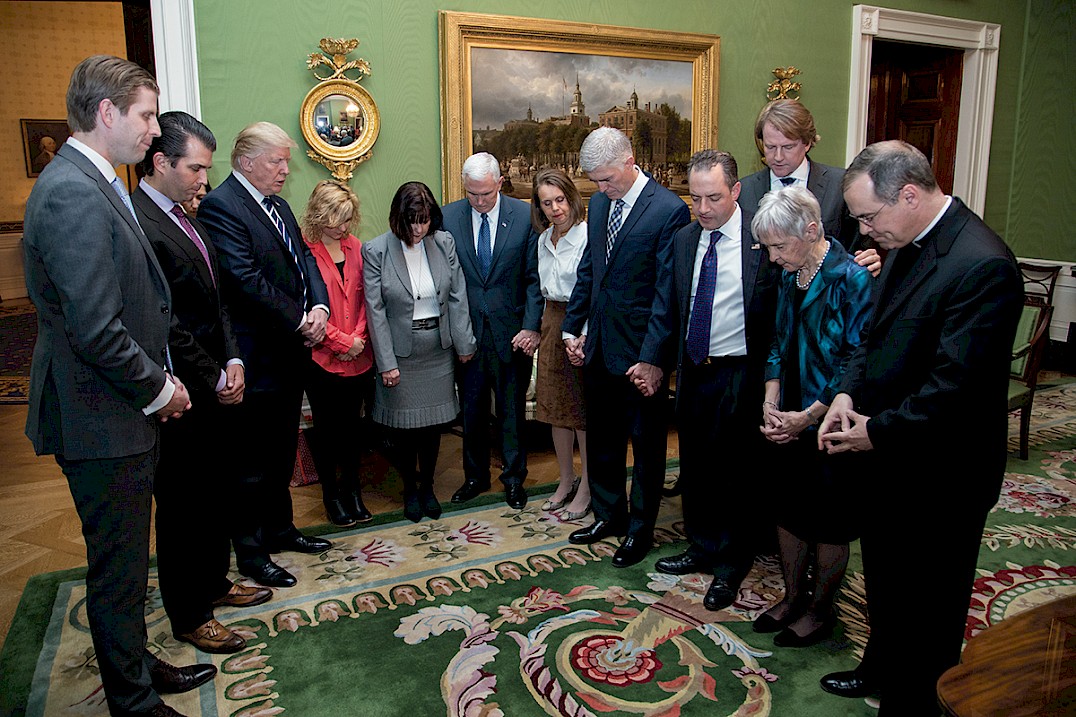
2. Considering the longer history of evangelical politics, were there forces of alter—both inside evangelicalism itself, as well every bit in American civilisation and politics writ large—that politically stirred evangelicals in the long lead-up to 2022 in unique and unprecedented ways? Stated another manner, was 2022 a pin in the life of mod evangelicalism and its political expressions and ambitions, or a continuation of existing—perchance accelerating—trends inside the move?
Griffith:
Both-and. The 2022 election was certainly a continuation of existing anti-feminism; the hatred of Hillary Clinton goes back to 1992 and her perceived insult to traditional stay-calm women ("Well, I guess I could have stayed domicile and broiled cookies …"). At that place is a lot to say about this! On the other hand, I also remember there was an dispatch of forces such every bit fear and anger toward both immigrants of colour and citizens of color that appeared to mobilize bourgeois religious voters to an extraordinary degree. Scholars are notwithstanding parsing this out, of course, and debating the politics of race in white evangelical voting patterns; but at that place's no question that white working-class men in many communities have adopted a narrative of victimization in which they are being left behind and displaced by "outsiders" (people of colour, immigrants, etc.). A big number of white women seem to back up this view and identify with these men's victimization; I suppose they find some measure of comfort in that narrative, even if it fuels their anger and paranoid fearfulness of outsiders. So what journalists continue seeing locally and calling "economic anxiety" is securely tied up with racist fears of who the culprits are. This is in no way limited to evangelicals, but many of those who are expressing this sense of victimization are evangelicals, hearing these narratives from pulpits like that of Robert Jeffress and other Trump supporters. The evangelical conventionalities that ane is "in but not of the world" and has thus willingly taken on the condition of a visitor to this evil globe lends itself pretty seamlessly to a sense of 1's own victimhood.
Fea:
Fear, the pursuit of power, and an approach to public policy built on an unhealthy dose of nostalgia have plagued evangelical politics for a long time. Since the 1970s, the Christian Right has followed a well-known political playbook. Its members want to elect the right president of the United States who will appoint the right Supreme Court justices who will then overturn decisions that the Christian Right believes accept undermined the republic'south Christian foundations. In the past, this playbook was inseparable from the moral character of the candidate. In 2016, however, the Christian Right executed the playbook in support of a candidate known for his sexual escapades, nativism, deceit, xenophobia, racism, and misogyny. This is a new evolution. The playbook survived despite the candidate. This is a testimony to the playbook's ability and the part that Christian Right leaders such equally Jerry Falwell and Pat Roberston played in reshaping American political civilisation.
Laura Gifford:
Evangelical voters have struggled since the 1980s under conditions of institutional "capture"—in other words, as an increasingly reliable GOP voting bloc, their desires and policy preferences are routinely articulated during campaigns, but these policies often neglect to gain much traction once candidates are in office. Ronald Reagan's courtship of the pro-life movement and subsequent failure to laissez passer meaning policy revisions stands as an case. Republicans recognize that maintaining the rhetoric of support for evangelical desires is more important than legislating policy that conforms to these desires—after all, where will evangelicals become? The Democratic party'south social positions, especially in the arena of sexual policy, render them anathema to many of these voters. While many Republican candidates are authentic evangelical conservatives with heartfelt commitments to the policies they proclaim from the stump, this voting bloc remains more effective in driving rhetoric than policy—a situation exacerbated past the presence of different ideological blocs within the GOP (economic conservatives who trend toward libertarianism, for example).
While Donald Trump's candidacy offered challenges to this structure, ultimately his election and continuing support by evangelical conservatives demonstrates its enduring strength. Trump combines poor personal beliefs (bullying, proper noun-calling, adultery) with rhetorical dedication to the policy preferences of evangelical voters. In other words, information technology doesn't matter how reprehensible 1 behaves if i toes the rhetorical line. That Trump acts upon evangelicals' desires on a scale at least equivalent to George W. Bush'due south assistants adds fuel to the fire of their support. Pro-Trump evangelicals are willing to forgive beliefs that would get one kicked out of Dominicus Schoolhouse if the leader of their party volition articulate their policy priorities—and nominate conservative candidates to the Supreme Courtroom.
What remains to be seen is whether evangelical support for Trump will cause them to "gain the whole earth and lose [their] own soul" (Mark viii:36). Does pro-Trump fidelity compromise evangelicals' witness? By condoning his behavior, practice pro-Trump evangelicals destroy their ain credibility? It remains to be adamant how evangelicals' strong support for Trump will play out in the future.
Martin:
This is a question of continuity and change. The political expressions of mod white evangelicalism have shifted on a few issues, including foreign policy approaches to Russia. However, there are themes amidst mod white evangelicals today that harken back to yesteryear, including the utilization of the traditional jeremiad in religious and political discourse, belief in a worldwide religious conspiracy, ballgame and sexuality, the courting of white supremacist ideas and support, and the overwhelming support of laisse faire/complimentary marketplace commercialism.
Reverends Billy Graham, Jerry Falwell, and a host of other evangelicals rose to prominence by using a traditional jeremiad to frame faith and politics. America was once a nation committed to God, they preached, only information technology experienced a marked moral and religious refuse on account of a number of turning points including materialism, new sexual and gendered norms, and lack of religious delivery. The but solution, they argued, was to look to the by (whether real or imagined) as a concrete model, a practical checklist to guide the religious and political agenda of the time to come. America had to replicate past norms in order reclaim or revive its condition equally a godly nation with a transcendent global mission. The evangelical embrace of Presidents Reagan and Trump's campaign slogan "[Permit'south] Make America Great, Over again," revives this moral and rhetorical narrative of the traditional jeremiad. America was once great. However, information technology experienced a marked reject. Returning to the by is the only way to make America peachy over again.
Closely related, Graham as well preached a gospel of anti-communism. He preached that communism was more than just a political ideology. Rather, it was a religion of godlessness, a global conspiracy aptitude on acquisition Christian America and thwarting the nation'southward transcendent purpose. Just a religious revival of born-again Protestants and the expression of that new birth in the public sphere could save America and the globe. Today, white evangelicals such as Reverend Robert Jeffress and Jerry Falwell Jr., to name a few, have argued that Islam and Islamic law are the biggest threats to the nation. Our only hope, they argue, is to re-commit ourselves to their notion of Godliness and elect politicians who will fight against this "global conspiracy."
Next, abortion specifically, and progressive gender and sexual politics more than broadly, continue to galvanize white evangelicals. The Roe v. Wade Supreme Courtroom conclusion, and the increased liberty it gave women over their ain bodies and sexuality, emerged equally one of the issues that motivated Falwell's moral majority and Phyliss Schlafly'southward Eagle Forum in the 1970s and 1980s. Today, it remains one of the superlative reasons white evangelical voters and organizations such as Ed McAteer's Religious Roundtable, Ralph Reed'due south Faith and Freedom Coalition, Tim LaHaye'south Council for National Policy, and Beverly LaHaye's Concerned Women for America cite for their electoral and fabric back up of President Trump, his administration, and his nominees for the Supreme Court.
White evangelical groups have also continued to appoint white supremacist ideas and support. White evangelists and religious leaders such as Gerald L.K. Smith, Frank Norris, Elizabeth Dilling, W.A. Criswell, Carl McIntire, Billy James Hargis, and Bob Jones, to name a few, endorsed and flirted with racist ideals and rhetoric including anti-miscegenation, endorsements for legal segregation, and opposition to civil and human being rights protests. Smith went further, founding the American First political party embracing pro-Nazi and anti-Semitic sentiments. Their opposition to civil rights, they argued, was rooted in the belief that racial desegregation was a communist plot at all-time, a demonic evil and unnatural undertaking at worst. Either way, permitting such things would topple the country's Christian foundations. Today, some white evangelicals have shied away from endorsing anti-Semitism and the idea that desegregation is a communist plot. However, prominent white male evangelicals such as Robert Jeffress, Pat Robertson, and Jerry Falwell Jr. and the elected officials they support, such as Attorney Full general Jefferson Sessions and President Trump continue to entrance hall explicit and thinly veiled arguments concerning how the very presence and growth of "indigenous" or religious others, especially Islam, possesses the potential to destroy America's (white) Christian foundation. Moreover, President Trump passively accepted the endorsements of known white supremacist organizations and officials. This cadre of modern white evangelicals and the constituencies they represent continually disavow racism and its place in mod society in favor of "colorblindness." Notwithstanding, their religious and policy positions and decisions consistently privilege white male heterosexual subjects while marginalizing others.
Finally, big concern. White evangelical business men of the 1930s, such as R. G. LeTourneau and Herbert J. Taylor, opposed Franklin Delano Roosevelt'south New Deal and its governmental interventions into business in favor of a gospel of gratuitous market place fundamentalism. These white businessmen merged their religion with corporate capitalism by integrating evangelicalism into their manufacturing and managerial roles and donated big sums of money to evangelical organizations. Moreover, they pushed and encouraged clergy to preach that individual salvation and costless enterprise went mitt in hand, while higher taxes, authorities regulation, and the "collectivism" of labor movements were the handmaidens of sin. Today, many white evangelicals champion a similar merging of evangelical religion and large business organization. One outstanding instance is the Green family, the owners of Hobby Vestibule. In addition to supporting evangelical organizations and schools such every bit Oral Roberts University and Liberty Academy, the family was at the forefront of the Burwell five. Hobby Lobby Supreme Court determination. The Greenish family claimed that their white evangelical faith forbad them from complying with the "interventionism" of federal regulations requiring that employer provided wellness insurance cover contraception. The court ruled in their favor, stating that Hobby Lobby and other "closely held" companies can choose to be exempt from sure laws that violate their religious freedom. In calorie-free of continued beliefs in a global religious conspiracy, debates almost abortion, the persistence of white supremacist ideology, and the influence of "Godly Businessmen," the 2022 ballot of Donald Trump—a businessman with no previous experience in political office—can be seen as revealing, more than than causing, the (re)-acceleration of a number of existing trends within the white evangelical customs.
three. We know the extent to which Donald Trump has redefined leadership in the Republican party and the political system. But to what degree has generational shifts in evangelical leadership also been responsible for—or a contributing gene to—the rise of evangelical Trumpism and the Trump moment? Have such pronounced shifts occurred earlier?
Gifford:
1 important distinction between current evangelical leaders and their forebears is that, while figures such as Billy Graham or Jerry Falwell Sr. navigated the developing world of the Religious Right, contemporary leaders often accept come up of age in a subculture in which evangelical conservatism has already been "captured" by the GOP. While Franklin Graham became involved in mission work during the 1970s, for example, and was elected president of Samaritan's Bag in 1979, he did non lead his first evangelistic issue until 1989—well after the Christian Right first aligned its interests with the Republican Party. Jerry Falwell Jr. was still a teenager when his male parent formed the Moral Majority.
Nosotros have seen occasions when evangelical leaders have opted to marshal themselves with specific political leaders. Billy Graham's relationship with Richard Nixon is an especially fascinating example, because the fallout from that relationship post-Watergate damaged Graham's reputation and convinced him to follow an apolitical path in the future. Given his full-throated support for Donald Trump, Franklin Graham conspicuously did not take a similar lesson from his father'south experiences. Whether and how evangelical leaders' relationships with Trump volition play out in the future remains open for debate.
1 central difference in our contemporary context is the prevalence of highly segmented, ideologically specific media that permit people of specific political persuasions to unite across geographic infinite. While polarized media is nothing new—nineteenth century newspapers, for example, were stridently partisan—our capacity to segment ourselves on a national scale does represent a newer evolution. To the degree conservative evangelicals tin can remain in "repeat chambers," they may not receive—or be receptive to—criticism of the younger Graham. Exposure past the "mainstream media," for example, may mean petty to someone who trusts Fox News and the Christian Broadcasting Network.
Martin:
Peradventure the differences between Reverend Jerry Falwell Sr. and Jerry Falwell Jr. is one identify to examine the generational shifts within white evangelicalism. Reverend Jerry Falwell Sr., an ordained Baptist minister, was a major effigy in the making of modern white evangelicalism and the moral bulk. He led Liberty Academy from its founding. Like Reverend Baton Graham, he attempted to bring a segment of white evangelicals from the sawdust trail to the respectful halls of power. However, Jerry Falwell Jr., the electric current president of Liberty University, has become an influential leader in white evangelical circles despite the fact that he embodies a unlike kind (or caste) of leadership than his begetter. First, ordination. Falwell Jr. is not an ordained minister, yet he has get a spokesmen of the Christian right. He has an undergraduate degree in religion and a police force degree. Formerly, ministers were the major mouthpieces of the Christian right, while lawyers played the groundwork. Falwell Jr. represents a new tendency, with lawyers out in front. Second, Falwell publicly eschews the respectability his begetter sought. He boasts almost beingness a "redneck" and having never played golf. Moreover, reverse to his father, he is not concerned with the public displays of professionalism, decorum, and piety of elected officials. Despite Trump'due south multiple marriages, admitted actress-marital affairs, payoffs to his dalliances, admitted sexually harassment, and multiple accusations of the same, Falwell Jr. claims that "evangelicals have found their dream president" in Trump. In fact, he has issued calls to true Christians to elect more than leaders similar Donald Trump, lest the forces of fascism destroy the state. "Conservatives [and] Christians demand to cease electing 'overnice guys,'" he tweeted. "They might brand neat Christian leaders but the U.s.a. needs street fighters like [Donald Trump] at every level of government [because] the liberal fascists Dems are playing for keeps [and] many Repub leaders are a agglomeration of wimps!" In improver, Falwell Jr. welcomes the influence Flim-flam News and other bourgeois talk radio host have upon white evangelicals. Whether equally a monologue or a feedback loop, these media outlets exact as much (perhaps more) power upon white evangelicals and their political commitments every bit ordained clergy. Tellingly, Falwell Jr. has dubbed Liberty University "the Fox News of academia." Unsurprisingly, some white leaders and students of previous generations have felt compelled to speak out against Falwell Jr. and his leadership, especially his support of the President Trump. Most notably, Mark DeMoss, a former aide to Jerry Falwell Sr. and the chairman of Liberty's Lath of Trustees' executive committee, resigned from the commission besides every bit the lath. Following Falwell Jr.'s support of Trump and advocacy for white evangelicals to practice the same, DeMoss left stating that the Trump campaign and Falwell Jr.'south support of the same were antithetical to the values for which Falwell Sr. and Liberty stood. This clash of ordination, piety, leadership, and influence is, perhaps, a microcosm of a broader generational separate and shift within white evangelical circles.
Griffith:
Generational shifts are certainly very of import here. Have the Southern Baptist Convention: the generation that spawned leaders such as Paige Patterson and Paul Pressler, masterminds of the "conservative resurgence" in that religious trunk (or what some would instead phone call the "fundamentalist takeover"), is now elderly. They are still fighting feminism tooth-and-nail, fifty-fifty equally Patterson, Pressler, and others of their ilk have been defenseless upwardly in #MeToo scandals on charges of sexual harassment, assail, and other misconduct. Younger generations are much more horrified by the misogynistic attitudes of their predecessors, and many of them are quite focused on social justice issues, from climate modify to immigration reform to structural racism. The generations do seem to be united in a common opposition to abortion, simply I would not be at all surprised if many in the younger generations were more willing to seek compromise on that upshot than were their forefathers. At that place is a lot more to say well-nigh this, just yes, there has been pregnant generational change in American evangelicalism, and I think nosotros could see some real shifts equally the younger cohorts have charge. I don't mean to paint an overly rosy flick here, every bit there are obviously plenty of Trump supporters amid younger people too; but my betoken is that there are existent differences in the priorities of the younger generations of evangelicals, and that's bound to have a concrete effect.
Fea:
The average Trump voter was 57 years old in 2016. Near of the evangelical leaders who back up him came of age politically during the clout of the Christian Right. In other words, these evangelicals came to believe that the pursuit of political power was the but correct fashion to engage public life or human action as a witness to the Christian gospel in the world. Thoughtful Christians such as Washington Mail columnist Michael Gerson, University of Virginia sociologist James Davison Hunter, Washington University law professor John Inazu, and the Dutch Reformed thinkers who congregate at schools such as Calvin College, have all offered alternative approaches to evangelical political engagement that have not focused on the pursuit of power. Rank-and-file evangelicals take largely ignored these approaches. This is yet another testimony to the power of the Christian Right playbook.

Trump with Jerry Fallwell Jr. Fallwell Jr. has been a vocal supporter of president Trump.
iv. Social "culture war" issues commonly loom big in historical treatments of the evangelical Right. Notwithstanding the success of Trump and the America First agenda has also drawn to the forefront other heated and divisive issues—business organisation with immigration, race, masculinity (misogyny), tariffs and economic protections, etc.—that historians have not commonly or singularly focused on when unpacking evangelical politics over the longue duree. Going forward, how should—how must—historians of evangelicalism thread these issues into our histories of its political mobilization? Into the history of evangelicalism?
Griffith:
I recently published a volume, Moral Combat, that argues strongly for greater attention to misogyny and its intersections with racism in our histories of religion and American politics. All along the mode, correct-fly political leaders have converted people to their cause past weaponizing fear; and generally, that fear has been directed at women, the LGBTQ community, and people of color. Christian leaders, both evangelical and Catholic, rely heavily on deep theological structures of gender hierarchy for maintaining guild within their ranks; and I believe evangelicals and Catholics may exist particularly susceptible to this weaponized fright for that very reason. Women coming to power upend the way the world is supposed to work, at to the lowest degree in the conservative churches where they are not allowed to occupy positions of highest leadership, and there may be something especially unsettling—for bourgeois religious women and men alike—about watching a woman such as Hillary Clinton come close to the highest leadership position in the United States, the presidency. In any example, yep, all of these factors are critically important and in many ways inseparable from one another. Information technology is a very tall order to complect them all together, particularly in a long history of evangelicalism and politics that covers an extensive span of fourth dimension; but the history is incomplete without whatsoever one of these factors present.
Fea:
As virtually historians of American evangelicals are enlightened, we cannot tell the story of this religious group without exploring its connections to the issues you describe. For example, fear that white Christian America is eroding has led evangelical conservatives to support Trump'due south border wall and Muslim bans. Fear leads evangelicals to remain silent when Trump separated immigrant children from their parents or claims that at that place were "skilful people on both sides" at Charlottesville in August 2017. As Christian nationalists, many white evangelicals believe that the Us was founded as a Christian nation—a "urban center upon colina" that has a special role to play in God's plan for the ages. Evangelicals thus believe that the federal authorities should do everything it can to protect the economical interests of this chosen nation. For many white conservative evangelicals, a potent economy is a sign of God's approval on the United States.
Gifford:
I'm non sure that problems including immigration, race, masculinity, and the economy can be differentiated from social "culture wars." All these issues represent a cultural divide that becomes "weaponized" very chop-chop. Clearing debates become a plebiscite on both crime and American civilization. Are we a nation of immigrants that welcomes diverseness, or is a core "Americanism" under threat from foreigners unwilling to assimilate? As I mentioned earlier, race has been pivotal in the formation of a quasi-evangelical political identity. Masculinity and misogyny, again, correlates to concerns near "American" values. Complementarian religious practice translates easily into arguments about the "proper" roles and characteristics of men and women. Concerns about the economy link to both immigration and to concerns well-nigh social status that often have gendered implications: if an "honest workingman" tin no longer mine coal or build cars for a living, what is America coming to?
I would argue that many scholars, from Daniel Grand. Williams to Jefferson Cowie and Laura Kalman, accept already engaged these issues, only I exercise concord that incorporating them into our histories of both political mobilization and evangelicalism remains vital. Perhaps more important is our capacity as historians to contribute to public policy conversations in means that subvert the "civilization war" dimensions of these issues. Yes, economic protectionism plays into stereotypes about gender and immigration—simply nosotros must also trace the history of blue-collar struggle in ways that illustrate where public policy has failed these citizens. By amalgam fuller pictures of our contempo history, and and so sharing them with policy leaders and the electorate, nosotros might generate more productive conversations about how we recognize the worth of all people, including those who feel abandoned past structural changes in the economy.
Martin:
I way scholars of white evangelicalism can move the field forward is to but proper noun power in their narratives. That is, point out that the story of white evangelicals in American is just that: a history largely of white heterosexual men and women. Naming it as such strips this evangelical story of the power of normativity, or equally the story. Some scholarly narratives of white evangelicalism neglect to name whiteness, maleness, and heterosexuality equally the social constructs and lived realities that shape their historical actors and the narratives they typhoon well-nigh them. These constructs are simply positioned every bit the norm. Race, for instance, is only mentioned or analyzed when people of color show upwards in the narratives. Similarly, gender functions as a synecdoche for women. Both contribute to the idea that only people of color and women are racialized or gendered subjects. Whiteness and maleness then are the normative heart. Simply put, to paraphrase Marla Frederick, scholars writing about white and male religious subjects in the history of evangelicalism oftentimes limited trivial concern about needing to specify that they are referencing white evangelicals. Too ofttimes white evangelical religious exercise by default has been categorized equally evangelicalism writ big, while the study of other non-white evangelicals sits solely under the category of "blackness" religious studies or "Latin@" religious studies. Appropriately, whiteness and maleness in the study of evangelicalism has operated equally a normative category. This proclivity precludes us from non only seeing other forms of evangelicalism in American history as equally accurate, but also hinders our ability to see how religion and race/gender et al. are constitutive. Moreover, when scholars fail to offer such specificity, ability and privilege can easily get mystified, something divinely orchestrated, or accomplished past the gods, not human action. In naming this phenomenon with such precision, scholars of white evangelicalism volition invite u.s. to come across that the merging of the organized religion and bourgeois politics were not inevitable or brought to u.s.a. by divine ability, but rather occurred because of the decisions and deportment of item people at particular times with real consequences.
five. To what degree are evangelicals who counted themselves as part of the 19% of non-Trump voters—and, for that thing, those among the purported 81% of Trump supporters—now revisiting the history of their faith tradition and community? Has 2022 triggered a new historical consciousness in evangelicalism? Or is evangelicalism trapped in a post-truth impunity, fully committed to its own alternative readings of America's past, nowadays, and future?
Fea:
I am sorry to say that we have made fiddling headway in convincing my fellow evangelicals to think more deeply about the relationship betwixt religion and politics and the links between Christianity and American identity. Well-funded pseudo-historians such as David Barton and Eric Metaxas continue to accept success in selling evangelicals a faulty view of American history. In my view, the dubious historical claim that America was founded equally, and continues to be, a Christian nation undergirds the entire Christian Correct, pro-Trump calendar. Evangelicals continue to gaze nostalgically into a by that is never coming back and, in the case of America's supposedly "Christian roots," may have never existed in the offset identify. It will take a lot of work to turn the tide.
Griffith:
I have non interviewed whatsoever evangelicals since the 2022 ballot, but I tin't imagine that the 19 percent wouldn't exist reckoning somehow with their history and their own deep differences with the 81 percent. Certainly a number of influential evangelical women—Jen Hatmaker and Beth Moore, for instance—accept sharply distanced themselves from the religious supporters of Trump politics. I spoke with some evangelical Clinton supporters before the election, and they expressed a lot of sadness that so many in their church—the Trump supporters—seemed mostly to be voting for their ain economical benefit while they feebly rolled their optics at the racism, misogyny, and other moral failings Trump exhibited throughout the campaign. That's the other thing to think about here: were evangelicals interested in voting for someone they believed would exist good for the nation as a whole, or were they focused on their own taxes? I don't think we know the complete answer to that all the same, only I'd suspect we'd observe a much stronger "me" emphasis amidst those evangelical voters than their Christian theology suggests should drive their moral worldview.
Martin:
Both phenomena are occurring. There are a number of white evangelicals who are revisiting and even disavowing the term, while others are even more committed. Peter Wehner, a senior boyfriend at the Ethics and Public Policy Center who served in the previous three Republican administrations has ceased to call himself an "Evangelical republican," while the Princeton Evangelical Fellowship, a campus ministry for more than eighty years, has changed its proper noun to the Princeton Christian Fellowship. Co-ordinate to Bill Boyce, the arrangement's director, the organisation is "interested in existence people who are defined past our organized religion and by our organized religion commitments and not by any sort of political agenda." Similarly, Michel Gerson, a one-time speechwriter for George Westward. Bush, and Reverend Tim Keller have both wrestled with the limits and possibilities of the label. Nevertheless, in that location are withal some powerful voices such as Reverend Paula White, Reverend Robert Jeffress, Jerry Falwel Jr., and others that have non just maintained their white evangelical bona fides, simply accept maintained that their brand of faith, that is white evangelicalism, is indeed synonymous with true Christianity. All other behavior are misguided at best, damned at worst.
Gifford:
Both of these elements may exist present. Amid not-Trump–supporting evangelicals, I exercise see heightened attention to how evangelical support for the Republican Political party may take resulted in the "capture" detailed above—and the capacity for 81 percent of fellow believers to support a candidate who explicitly breaks many tenets of their ain moral code. I run into some grounds for optimism as people of conservative religious faith begin to thoughtfully examine the dynamics of their witness in the public arena. I as well encounter horror on the part of non-Trump evangelicals that not-Christians may see the current administration'south behavior—and evangelical Christian support for the administration—as an indictment that seriously damages evangelical brownie.
On the other hand, we accept managed as a guild to create such comprehensive repeat chambers for sharing ideas and information that many pro-Trump evangelicals volition continue to believe the narratives their faith leaders disseminate. Note, nevertheless, that this is a trouble that transcends party and religiosity. Conservative evangelicals may in some cases be trapped in a "mail service-truth dispensation," but the aforementioned could be said of many Americans identifying with many different ideological persuasions and communities. Liberals should hear conservative perspectives, and conservatives should hear liberal perspectives. We may non agree, nor practice all sides of an argument always behave like factual weight, but failure to listen beyond boundaries renders us all incapable of crafting workable solutions to policy issues.
6. Is "evangelical" a political or theological term, and what does the time to come of its usage by built-in-once more devotees, and by students and scholars of the "movement," hold?
Gifford:
I would categorize "evangelical" as a contested term, only context matters. In faith circles, mainline Christian denominations continue to hold onto the theological foundations of the term "evangelical." After all, the root of the discussion, euangelion, simply ways Good News—the Gospel annunciation of God's love for all creation that lies at the root of Christian faith. Seeing "evangelical" in theological terms explains why a progressive denomination such as the Evangelical Lutheran Church in America, for example, keeps the "Eastward" in "ELCA."
In the context of the American political mural, however, I doubtable that for the foreseeable future "evangelical" is and will be a political term defining a specific type of Christian civil faith. Theological "evangelism" necessitates a political witness—after all, much of what Jesus of Nazareth taught had real political implications. Political "evangelism" in the American context indicates a partisan witness. Theological "evangelism" professes Adept News that transcends nationality. Political "evangelism" prioritizes patriotism.
Sadly, non-Trump–supporting evangelicals of all persuasions—mainline, bourgeois, and otherwise—struggle to articulate a Christian witness amidst Americans disillusioned past the perceived hypocrisy of a population that doesn't seem to be living out the euangelion. I would love to meet students and scholars of political "evangelism" further refine their definitions of this constituency. Too often the academy falls into the trap of equating "Christian" with "political evangelical." Such errors elide the true complexity of American religious belief.
Griffith:
Information technology's difficult to brand a credible case now for "evangelical" as anything just a political term. There are many, many church building leaders and members now who are disavowing that identifier—even though they may take identified proudly as evangelical in the by—because they practice not support Donald Trump and are profoundly dismayed and angered by those Christians who support his policies. I spoke at one such church in California recently and was actually struck by the shock and dismay church members expressed toward their co-religionists for paying and so picayune attending to Jesus'southward actual words and actions as recorded in the New Testament. Actually, these Christians were quite livid nearly this and very committed to a Christian do focused on caring for the neediest in society. In every other way they look a lot similar conservative evangelicals everywhere, downward to the repetitive praise songs in their worship service; but because of the political implications, they have completely rejected the "evangelical" label they once wore. Scholars volition have to develop some better terminology for distinguishing between these different groups of Christians who hold such radically unlike views about the values embedded in their religion. Analysis of the differences between the Trump-voting "evangelicals" and the Clinton (or Bernie Sanders)-supporting "progressive Christians" has really helped illuminate the fact that there are not merely different types of Christianities in the United States today, at that place are actually polar opposite versions of Christianity that are warring against one another in the name of their religion. That's been a long time in the making, and it'southward both a religious and a political phenomenon that I think will exist with united states for a long fourth dimension to come.
Fea:
The word "evangelical" comes from a Greek word meaning literally "good news." For centuries, Christians take thought about the "good news" in terms of the Gospel of Jesus Christ. "Evangelical" has always been a theological term. An "evangelical" believes that Jesus was born, died, rose from the grave, and volition 1 day come again to judge the living and the dead. Ever since the ascension of the Christian Correct in the belatedly 1970s, pundits and commentators have used the word "evangelical" to describe a voting bloc. In other words, "evangelicals" are just one more lobbying grouping. "Evangelical" is rarely used as a descriptive label by ordinary born-again Christians—men and women who believe in the inspiration of the Bible and the necessity of evangelism and activism. Very few of the churches' political pundits described as "evangelical" use the term. I recently met with several dozen college students at what many would call an "evangelical" college and few of them use the label, preferring instead to phone call themselves just "Christians."
For some scholars, the word "evangelical" has lost all pregnant. Some would contend that the word is a cover for racism, patriarchy, and all kinds of Trumpism. Perhaps this is truthful. Just scholars have been assuming that religious conventionalities is really a guise for something else always since Karl Marx declared that religion is the "opiate of the masses." When we interpret "evangelism" to mean something other than a securely held religious movement that provides its adherents with a sense of spiritual transcendence and enchantment in a natural and disenchanted world, nosotros run the take chances of undermining a generation or two of historical scholarship arguing that religious belief is a legitimate interpretive category, not a front end for something else.
Martin:
Evangelical is a theological and ecclesiology term with accompanying political commitments. Specifically, white evangelicalism, to paraphrase Steven P. Miller, is a religion perspective, identity, and worldview with significant sociopolitical implications. Today, as in the past, it continues to have an ecumenical draw, with adherents from the Missouri Synod of the Lutheran Church, Presbyterian Church in America, the Southern Baptist Convention, and host of other religion communities from the Reformed, Pentecostal, Holiness, charismatic, and nondenominational traditions. Moreover, it continues to boast a small-scale only significant interfaith coalition of Jews, Catholics, and Mormons. Seen in this way, the term, its usages, and its political implications will keep to hold some degree of ability and sway among followers, students, scholars, voters, political hopefuls, and the general public akin for the foreseeable future.
Authors
JOHN FEA teaches American history at Messiah College in Mechanicsburg, Pennsylvania. You can follow him @johnfea1. He is an OAH Distinguished Lecturer
LAURA JANE GIFFORD is an independent historian of modern American political history. Her publications include The Center Cannot Concord: The 1960 Presidential Election and the Rise of Modern Conservatism (2009) and the co-edited book (with Daniel K. Williams) The Right Side of the Sixties: Reexamining Conservatism's Decade of Transformation (2012).
R. MARIE GRIFFITH is the John C. Danforth Distinguished Professor in the Humanities at Washington University in St. Louis. She is a historian of religion in the U.S. specializing in gender and sexuality, and she is the author or editor of six books. Her latest is Moral Gainsay: How Sexual activity Divided American Christians and Fractured American Politics (2017). She is an OAH Distinguished Lecturer.
LERONE A. MARTIN is Associate Professor of Religion and Politics in the John C. Danforth Middle on Religion and Politics at Washington University in Saint Louis. Martin is the writer of the award winning Preaching on Wax: The Phonograph and the Making of Modern African American Faith (2014). In support of his inquiry, Martin has received a number of nationally recognized fellowships, including the National Endowment for the Humanities, The American Quango of Learned Societies, and The Woodrow Wilson National Fellowship Foundation. His commentary and writing have been featured in the New York Times, and the Boston Globe. He is currently writing a volume on the human relationship betwixt religious broadcasting, the FBI, and national security in American history. The book will be published past Princeton University Press.
Source: https://www.oah.org/tah/issues/2018/november/evangelicalism-and-politics/
0 Response to "Born Again Christian Bill Williams St. Louis Mo"
Publicar un comentario