Vrchat Uploaded Avatar Appears as Red Sillouete
Avatar Performance Stats and Rank Blocking
In VRChat 2018.4.four, we implemented the Avatar Performance Stats and Ranking arrangement. This system was designed to be informative and let users run across the rough performance price of the various components on their avatars. Equally a whole, this system has been successful in letting users know which components are heavyweights on their avatars, and we've seen massive Community efforts in optimizing their avatars.
In VRChat 2019.ii.4, we volition exist making some vital changes, fixing some bugs, and changing some base behaviors of the Avatar Functioning Stats arrangement that all users should know almost. We'll encompass the changes first, and so talk about why we've implemented them.
Performance Ranking — VRChat on Oculus Quest
Until now, the Operation Ranking arrangement on VRChat for the Oculus Quest has been identical to the PC rankings. Although the Oculus Quest is quite a powerful mobile VR headset, it is not every bit powerful as a PC. We did not have adapted numbers bachelor for Quest on launch, merely nosotros will be implementing these rankings for Quest in VRChat 2019.2.4. See these values below!
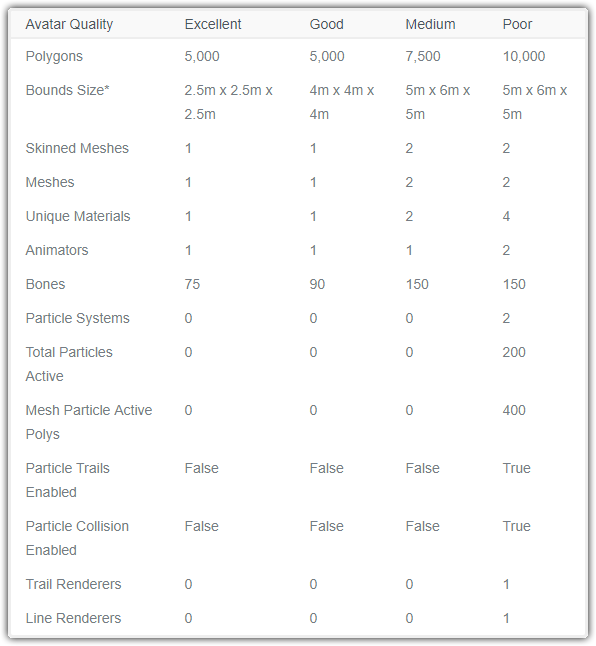
If yous compare this against our current Avatar Functioning Ranking numbers, you'll observe nosotros've omitted rows for components that are disabled on avatars on VRChat for Quest, like Dynamic Basic or Lights. These values will still appear on your Avatar Performance Ranking readout, but they will always be zero.
Minimum Displayed Operation Rank
With VRChat 2019.2.iv, we volition also exist implementing the Minimum Displayed Performance Rank option. You lot can choose to block avatars based on their Avatar Functioning Rank. This option is available in the "Operation Options" menu, accessible as a push in the top-correct of the Safety tab in the master menu.
When you choose a Functioning Rank in this card, all avatars that are beneath that rank will be blocked by default and replaced with a placeholder avatar. You can choose between "Medium", "Poor", or "Very Poor".
On VRChat for PC, the Minimum Displayed Operation Rank is set up to "Very Poor" by default. This means that no avatars are hidden past default on PC. You can choose between "Medium", "Poor", or "Very Poor" options.
On VRChat for the Oculus Quest, the Minimum Displayed Performance Rank is set to "Medium" by default. You tin can choose to modify this to "Poor" to allow showing avatars of that rank, just you lot may encounter performance bug. In addition, y'all cannot select the "Very Poor" level on VRChat for Quest. In other words, avatars that are ranked as "Very Poor" will never display on VRChat for the Oculus Quest. Any avatar that exceeds the limits given above for "Poor" will be ranked equally "Very Poor".
Regarding polygons in item, users on VRChat for the Oculus Quest volition not see avatars exceeding 10,000 triangles (polygons). Whatsoever avatar on VRChat for Quest exceeding ten,000 polygons will never be displayed.
In addition, avatars that are ranked "Very Poor" will not be permitted for upload when uploading avatars for the Android platform using the VRChat SDK.
Farther Avatar Operation Ranking Tweaks
At that place are a few other major changes that aren't large enough to become their ain section.
Outset, all GameObjects and Components are at present counted in the Avatar Performance Rank adding, including disabled GameObjects or Components. For example, if you have many disabled components for use in an blitheness, you may detect that your Avatar Performance Rank will drop.
If any mesh on your avatar has "Mesh Read/Write Disabled" checked in the asset's Import options, the Avatar Operation Ranking info panel will brandish "Mesh Read/Write Disabled" in the Polygons field, and the avatar will be automatically marked as "Very Poor". This as well occurs for Mesh Particle Polygon Count.
Avatar premises size will no longer reduce your Avatar Performance Rank below Medium.
Finally, nosotros've changed the manner that several components and values were counted and then that they study accurate values in both the SDK and in VRChat.
Why the changes?
The first implementation of the Avatar Performance Stats system was fairly basic, and included a few problems. We've wanted to improve this organization for quite some time, so the changes necessary for Quest provided an opportunity to refine this arrangement further for all of our platforms.
As nosotros noted in our documentation, patch notes, and previous blog posts, avatars in VRChat on Quest were ever intended to accept limits enabled. This system was not ready for deployment when VRChat for Quest was launched, so it was delayed.
The changes on VRChat for Quest are necessary to ensure the best experience possible with the hardware provided. The values we chose for these limits were affected both past Oculus' recommendations for their hardware as well as our internal benchmarking of VRChat on Quest.
For PC, we've wanted to implement an optional mode to block avatars based on Performance Stats Rank since the initial implementation. We've also had several user requests for such an option. Leaving the arrangement up to user pick was a primary goal, and we did not want to affect the experience of users unless they chose to enable information technology themselves.
Finishing Up
We don't have a appointment for VRChat 2019.2.4 yet, only it is the adjacent release on our roadmap. Since this change affects avatar creators quite heavily, we wanted to permit you know every bit early on as possible.
We've got some other stuff on the way, too! Continue an eye on our #open up-beta-info channel on our Discord and sign upwards for Open Beta notifications, and we'll permit you know when we've got a new build ready for testing.
Source: https://medium.com/vrchat/avatar-performance-stats-and-rank-blocking-1ae0feddc775
0 Response to "Vrchat Uploaded Avatar Appears as Red Sillouete"
Publicar un comentario