what font is similar to times new roman but smaller
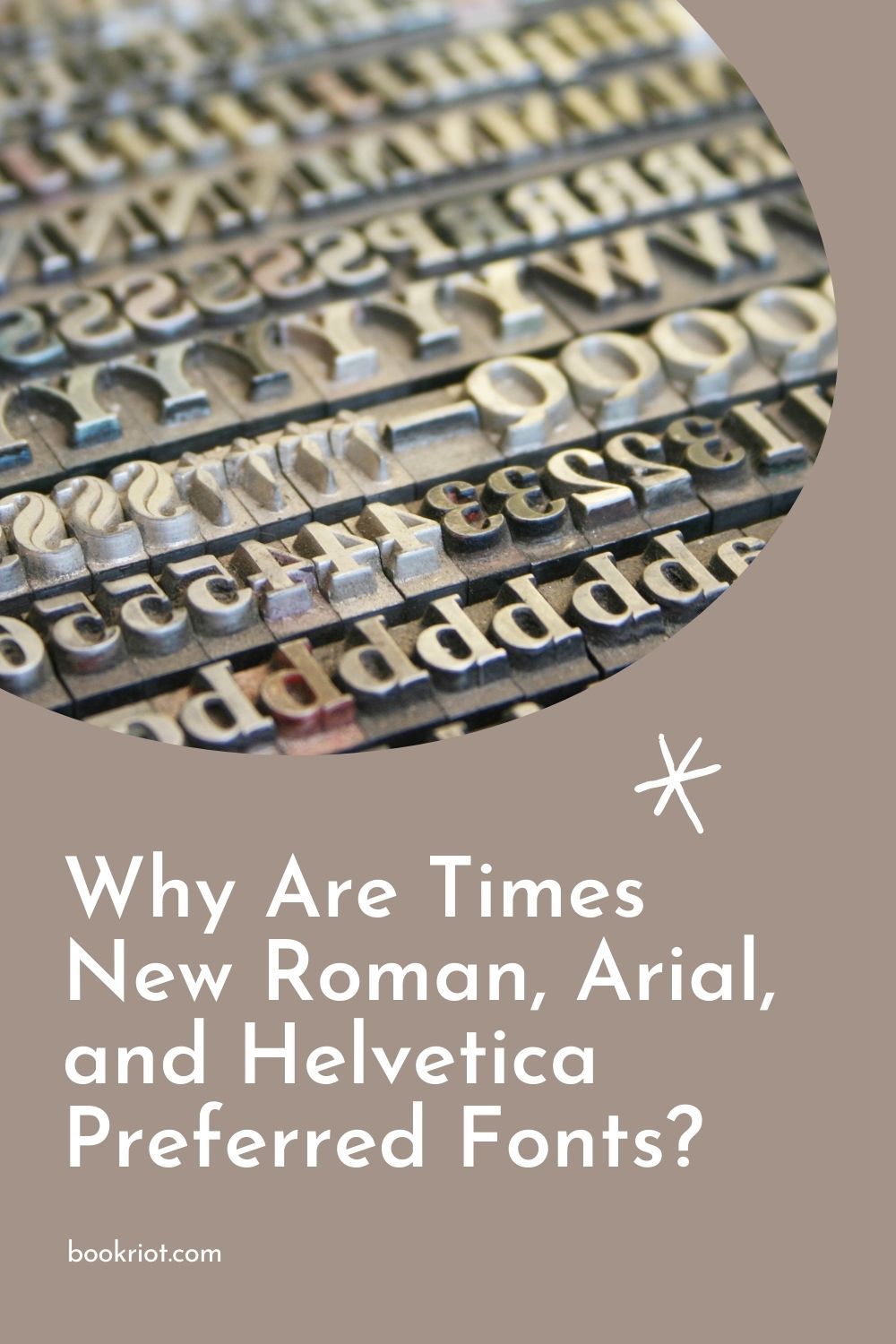
There are hundreds of thousands of font styles out at that place in the world, and yet the mainstays in English and Latin-based languages typically eddy down to just 3: Times New Roman, Arial, and Helvetica. They are everywhere, whether we like information technology or not: from the papers we wrote in high school to the books we read to instruction manuals to advertisements to journals and newspapers. Somehow, this trio has led the pack of font styles for decades, and became the fonts of option for a multitude of companies, operating systems, and unabridged industries.
Let's observe out how they became the most widely used fonts ever.
Serif vs. Sans Serif Fonts
In order to really sympathise why these three are so popular, nosotros need to get to know two common categories for typefaces: serif and sans serif.
Serif fonts use embellishments and flourishes in their characters, which serves the dual purpose of being both decorative and distinct.
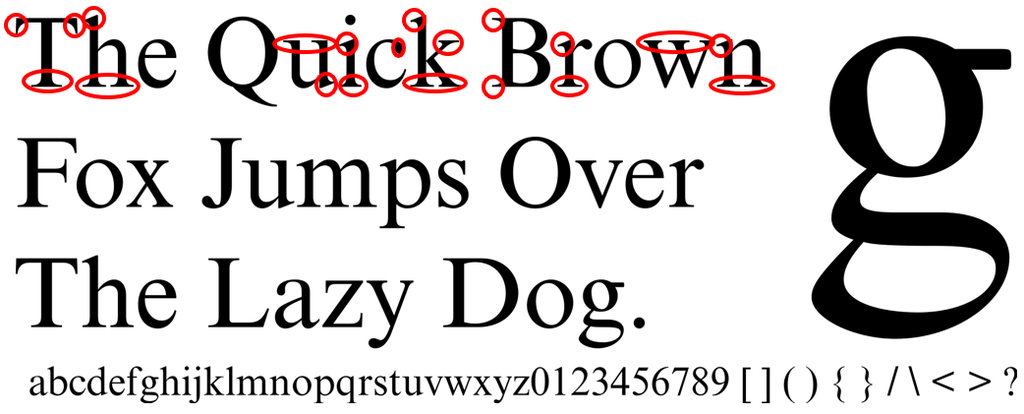
See those stroke flourishes circled in blood-red? Those are serifs, which are also called "tails" or "anxiety." The very look of a serif font is soft, with more rounded characters, and the distinctions of the serifs make the letters easier to read and recognize quickly. Some serif fonts y'all may have used or seen include Times New Roman, Garamond, and Bodoni.
Serif typefaces are older, dating back to the 18th century when they were designed for the press press. Because of that longevity, they're often seen equally more than traditional fonts. If a company is looking to convey trustworthiness and reliability to their consumer base of operations, for instance, they'll probably choose a classic serif font to communicate that (such as Apple's Garamond and the Starbucks'south Lander, which they utilise for their more than "expressive" advertising).
Sans Serif fonts have no frills and no fuss, hence the proper noun; sans ("without") serif. They use make clean, simple lines for their characters and lack the "tails" and "feet" of serif fonts. If you lot take an iPhone, you encounter a sans serif font every time you're on information technology—the iOS uses SF Pro.

These fonts are the modern younger siblings of the serif fonts, and are often used to convey a youthful, updated vibe. The character shapes are more geometric in nature, which means they're 1) easier to read on screens and ii) calibration large or minor quite well. Although, to be off-white, the notion that sans serif fonts are better for estimator screens and serif fonts are ameliorate for print is an older one, when screen resolutions weren't as smashing and serif fonts lost their distinction the smaller they got. Thanks to today's higher resolution screens, this is no longer a problem. Many, many logos use sans serif fonts, including Target (Helvetica) and Google, which famously made the switch from a serif font to sans serif back in 2015.
A Quick History Lesson
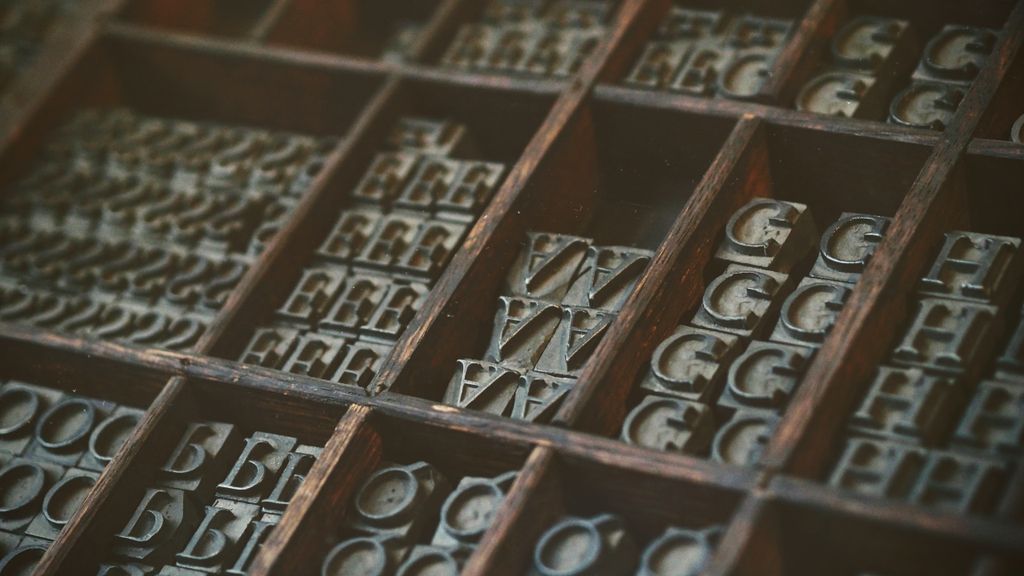
Times New Roman was introduced to the world in 1932 past type designer Stanley Morison. He was given the claiming of rebranding London's paper The Times with a fresh new font, and worked with draftsman Victor Lardent to create a serif font that was efficient, in order to maximize the amount of words that could fit in a line and on a page (very important for a newspaper), and readable, since impress newspapers go pretty darn small with their font sizes.
The Times endemic exclusive rights to their font for well-nigh a year, and then it slowly began to accept off with American publishers a few years later. According to the New York Public Library, monthly mag Woman's Home Companion was the start to adopt Times New Roman in 1941, and the Chicago Lord's day-Times started using it in 1953.
Helvetica originated in Münchenstein, Switzerland, in 1957 as a committee for the Swiss Haas type foundry. Max Miedinger designed the sans serif typeface to revitalize the company's sans serif offerings with something more modern and international, since their electric current selection wasn't doing so hot. Haas type foundry eventually made a deal with German type foundry D. Stempel AG to manufacture Helvetica for traditional print and widespread achieve. D. Stempel AG was afterward absorbed past the Linotype Company (this will be of import later, stay with me).
Arial was born in 1982 to creators Robin Nicholas and Patricia Saunders for Monotype Corporation, another company that specializes in typesetting and typeface design. This sans serif font is the first of the agglomeration to exist designed specifically for laser printing and personal computers. If you always wondered why your Windows figurer converts PDFs using Helvetica font to Arial, the most like font the system can find since it doesn't support Helvetica, it'southward because Arial was literally created to exist an echo of Helvetica…which is owned by the Linotype Company, a competitor of Monotype.
Why Do Nosotros Love Them So?
We have Microsoft and Apple to give thanks for that.
Microsoft's Principle Software Technology Manager, Greg Hitchcock, wrote extensively virtually Microsoft and Apple's cross-license agreement for font engineering back in 1989. This would essentially standardize fonts and printer software across the two operating systems, which were respectively named TrueType and TrueImage. Their core fonts would have been more than identical…except each calculator behemothic licensed their fonts from different typesetting companies. Microsoft used Monotype, and Apple used Linotype. Thus Microsoft's core fonts were Times New Roman, Arial, and Courier New, and Apple's cadre fonts were Times Roman, Helvetica, and Courier.
(Fun fact: Times New Roman and New Roman are essentially the same font, but the original typeface hardware for The Times's font was created jointly past, y'all guessed information technology—Monotype and Linotype. They both made sets of the typeface available, simply under 2 slightly different names: Apple tree chose Linotype'southward Times Roman and Microsoft chose Monotype's Times New Roman.)
So why was Times New Roman 1 of the chosen few? Because in the early computer days, most documents were printed, and this serif font was widely available and designed for print. On top of Times New Roman showing up on anybody's Windows computer every bit the default font, almost printed school assignments in the U.S. (please right me if I'k wrong: I'd honey to know what fonts were preferred in other countries!) following the MLA or Chicago style required a Times New Roman, 12 pt font.
The thing is, MLA doesn't require Times New Roman, and neither does Chicago Mode. They just used this font as an case of an "easily readable typeface" in their formatting recommendations. Since Times New Roman was the default for the figurer operating system that most people could afford, it must have been the path of least resistance to standardize all document formatting to Microsoft Give-and-take's default font.
Arial grew in popularity both considering of its choice as a Microsoft core font and its design every bit a sans serif. It was, quite simply, the most attainable sans serif font available to most people with computers, and sans serif fonts were growing in popularity with the increase in computer usage. Although Helvetica is the superior sans serif font to many, Microsoft chose Arial in part because the licensing fee for Helvetica was besides expensive. For a good 17 years, Arial was the Windows default font for PowerPoint, Excel, and Outlook, and and then information technology became the font of pick for everyone'south presentation decks, spreadsheets, and emails.
Helvetica had a slightly dissimilar trajectory to stardom, which began much earlier than either Times New Roman or Arial. Information technology was created at a perfect time in history, when post-war modernism was still influencing the arts, architecture, and literature, and then the media world was set for a uncomplicated, withal versatile typeface that'southward like shooting fish in a barrel to read. Helvetica was designed to adjust to any sort of branding, and became the darling of the advertising world, which is why it is everywhere and even earned itself its own documentary. Compound that with Apple championing it equally its default font, and you lot have a font used heavily in graphic design for corporate logos, editorials, and fifty-fifty transportation signage (it'southward the font of choice for the New York Urban center subway and the government of Canada).
Irresolute Times, Changing Fonts
Even though these three musketeers have been leading the charge of font usage for decades, times do alter, and and so do font preferences. A lot of this is also driven by our increasing screen time and a decrease in the usage of print fabric, which fonts like Times New Roman were created for. Microsoft Word replaced both Times New Roman and Arial equally their default fonts in favor of Calibri, a sans serif font, in 2007. Co-ordinate to Joe Friend, the Senior Programme Manager at Microsoft whose team pushed for this alter, it was a outcome of growing digital consumption and an effort to modernize. Calibri was also a newer font designed to improve screen readability.
Print books are besides rarely printed in Times New Roman. Although information technology's a serif font, and serifs are easier on the eyes for long-form reading, it was originally a newspaper font, and as boyfriend Rioter Ashley Holstrom noted in her piece on the all-time fonts for books, most book designers adopt fonts such as Garamond, Palatino, and Jenson.
At that place you have it, friends. May y'all leave this article with a greater appreciation for fonts, and may you see Helvetica around every corner. (Y'all will. Oh, you will.)
Source: https://bookriot.com/history-of-popular-fonts/
0 Response to "what font is similar to times new roman but smaller"
Publicar un comentario