Las Meninas by Is an Example of Baroque Art in Spain
Las Meninas
- Date of Cosmos:
- circa 1656
- Culling Names:
- The Family of Felipe 4
- Height (cm):
- 318.00
- Length (cm):
- 276.00
- Medium:
- Oil
- Support:
- Canvas
- Subject:
- Scenery
- Art Motion:
-
Bizarre
- Created past:
- Current Location:
-
Madrid, Spain
- Displayed at:
-
Museo Nacional del Prado
- Possessor:
-
Museo Nacional del Prado
- Las Meninas Page's Content
- Story / Theme
- Assay
- Critical Reception
- Related Paintings
- Creative person
- Art Menstruum
- Bibliography
-

Las Meninas
-
The participants in Las Meninas
-
Las Meninas
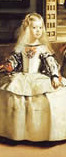
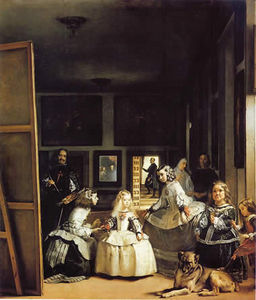
Voted every bit the all-time painting in the history of art in 1985, Velázquez'southward Las Meninas is almost incommunicable to define. At the most bones level, the painting is a grouping portrait of the v-twelvemonth-quondam Infanta Margarita, her ladies-in-waiting and other members of the courtroom, the King and Queen of Spain, and Velázquez himself.
At the aforementioned fourth dimension, information technology is also a painting almost art, illusion, reality, and the creative human activity itself, likewise equally a claim for the nobility of artists and the fine arts in general.
Las Meninas is prepare in the One thousand Room (the Pieza Principal) of the deceased crown prince Baltasar Carlos's living in quarters. King Philip IV gave the room to Velázquez in the 1650s to use as his personal studio, a very high honor indeed.
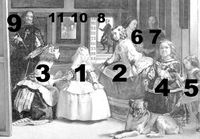
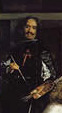
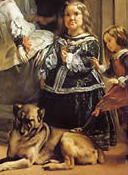
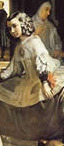
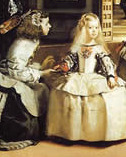
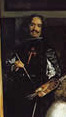
The participants in this piece include: In the middle: the Infanta Margarita (i), flanked to the right past lady in waiting Dona Isabel de Velasco (2), and on the left María Agustina Sarmiento de Sotomayor (3). To the correct of the picture aeroplane are the two dwarves: the German language woman Maribarbola (four), and the Italian human being Nicolas Pertusato (five), who is caught in the act of kicking the poor, aggravated royal hound. Behind this grouping are the royal chaperone, dona Marcela de Olloa (six), and an bearding bodyguard (7). In the deepest level of the painting, framed in the brightly lit doorway is the Queen's Chamberlain and head of the royal tapestry works, Don José Nieto Velázquez (viii), a possible relative of the artist. Finally, the Rex and Queen (10, 11) are present in their reflection in the mirror on the rear wall of the room. Velázquez (ix) himself appears to the far left of the composition, painting an enormous canvas with its dorsum turned towards the viewer.
The Commission:
Las Meninas was nevertheless another commission from the Rex. By the time Velázquez fix to piece of work on this, the apogee of his oeuvre, he had been the official court painter for xxx-three years.
The neat majority of his work at courtroom consisted of painting royal portraits (he painted at least forty portraits of Philip Iv alone), and this picture was essentially commissioned every bit more of the aforementioned: a group portrait of the royal family unit and their attendants. On and so many levels, yet, the painting is much, much more.
-
Las Meninas
-
Las Meninas
-
Las Meninas
-
Las Meninas


The Limerick:
If Las Meninas was voted as the greatest painting of all time, it is largely due to the boggling and innovative complication of the composition. Velázquez's painting may announced relatively simple and straightforward at outset glance, but a closer inspection reveals that Las Meninas is a composition of striking intricacy.
• Layers of depth:
the picture plan of Las Meninas is divided into a grid system, of quarters horizontally, and sevenths vertically. Furthermore, the canvas is divided into 7 layers of depth, as well. Las Meninas has the deepest, most carefully defined space of whatsoever Velázquez painting, and is the simply painting where the ceiling of the room is visible.
• Patterns and connections:
For such a large, multi-figure composition, first-class organization is of the essence. Velázquez managed to instill lodge in Las Meninas by utilizing a system of curved and diagonal lines. He ordered the figures in the foreground along an X shape with the baby Margarita in the center, thus emphasizing her importance and making the five-twelvemonth-sometime kid the focal point of the limerick.
Velázquez masterfully uses calorie-free and nighttime to farther society the composition. With calorie-free and shadow, he creates a organisation of double arcs that further centralizes the Infanta, 1 in a higher place that starts with Velázquez, descends to the Infanta, and rises to Nieto in the background, and one beneath, created past the arc of light in the foreground.
• Frames:
Velázquez's Las Meninas is a motion picture about frames and framing. All the figures are framed by the very room in which they are situated, while literal frames exist in the form of the canvass on the left, the frames of the paintings on the rear wall, the doorway that frames Nieto, and finally the mirror that frames the royal couple.
Manner:
Stylistically, Las Meninas is similar the sum of the all-time parts of all of Velázquez'due south earlier paintings. Just like his early on bodegones, the paintings is marked for its intense, Caravaggesque chiaroscuro, a limited and somber palette, a photo-like realism, and remarkably loose, free, unrestrained brushstrokes.
Las Meninas Analysis
-
Las Meninas
-
Las Meninas
-
Las Meninas

Velázquez'due south Las Meninas is perhaps the painting most open to interpretation in the entire history of art. The post-obit are the most prominent and most plausible interpretations, put forth by the most erudite of fine art historians.
One of the earliest and most widely accepted interpretations of Las Meninas is that the painting is Velázquez's personal manifestation of the inherent dignity of painting. The painting was executed during the years of Velázquez's attempts to gain admission into the elitist Guild of Santiago, who turned the artist downward twice (despite the support of the King and the pope) because of his creative person status.
In 17th century Spain, artists were grouped in the same social level as blacksmiths or tailors, considering they were paid for labor they did with their easily. Velázquez fought for most of his career to elevate the status of the arts in Spain to the aforementioned level of respect and adoration as in Italy.
Numerous clues in the painting back up this estimation, for example, Velázquez is shown in the private quarters of the deceased crown prince, in the company of the Male monarch, Queen, and the final remaining heir, and just the very closest members of the courtroom: he is, in essence, a function of the family.
Recently, a new interpretation has been put forth, suggesting that the painting might have been commissioned in lite of some very particular circumstances. At the time that Las Meninas was painted, the crown prince Baldasare Castiglione had passed away in a riding accident and the Infanta Margarita was the King's simply surviving child.
There has been speculation that before the nascency of Carlos II, the monarchy was because grooming the Infanta to eventually rule the country, similar Queen Christina of Sweden.
In a more general sense, many art historians accept proposed (undoubtedly with reason) that Las Meninas is essentially about the human relationship between reality and illusion, life and fine art, a consuming preoccupation during the Castilian Baroque.
Las Meninas Disquisitional Reception
-
The Family of Charles Four
-
The Daughters of Edward Darley Boit
-
The Purple Family at Buckingham Palace
-
Las Meninas
-
Portrait of Juan de Pareja Adjusting a String on His Mandolin
-
Richard Hamilton
-
Eve Sussman
-
Las Meninas
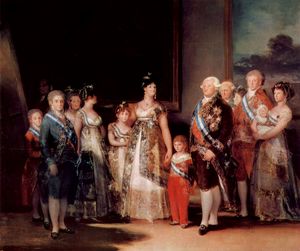
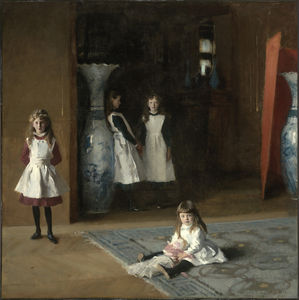
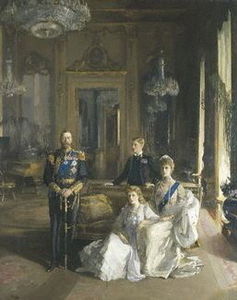
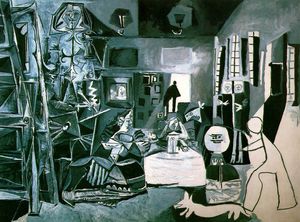
Of whatsoever painting from the entire history of art, Velázquez'due south Las Meninas must be one of the most inspirational of all time. Not merely has the painting inspired a veritable library's worth of written scholarship, but information technology has inspired the creation of some of art history'south almost of import masterpieces. The following list constitutes a sort of family tree founded by this landmark painting;
Goya, Family unit of Charles Four. 1800:
This royal court painter carefully studied his Velázquez before executing his portrait of the imperial family unit. From the Baroque artist, Goya learned to depict the subtleties of calorie-free and shadow. The composition bears obvious similarities to Las Meninas and like Velázquez, Goya manages to convey a strangely sinister atmosphere with his seemingly innocent painting, speaking volumes most his creative subjects.
John Singer Sargent, The Daughters of Edward Darley Boit. 1882:
Sargent consciously followed the example of Velázquez's Las Meninas when he executed this portrait of a fellow expatriate family for the Paris Salon of 1883.
Sir John Lavery, The Imperial Family at Buckingham Palace. 1913:
Legend has it that Male monarch George V decided to take the function of Philip IV literally when he dropped by Lavery's studio and asked to exist immune to employ some paint himself, just like Philip IV allegedly practical the red cross of the Guild of Santiago to Velázquez's chest afterward the painter passed away.
Picasso, Las Meninas. 1957:
Boyfriend Spaniard Picasso was long enamored by the Spanish Baroque principal. He spent many years of his childhood studying Velázquez in the Museo del Prado and from August to Dec in 1957, this famous modern creative person shut himself upwardly in his studio near Cannes to devote himself to the study of Velázquez's Las Meninas. The result was fifty-eight carve up studies of the painting, the sizeable bulk of which retained the same bones figures and composition, merely radically distorted everything else.
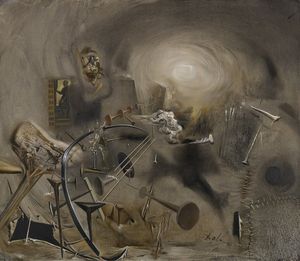
Salvador Dalí, Portrait of Juan de Pareja Adjusting a String on His Mandolin. 1960:
Just like Picasso, this Spaniard could not escape his national artistic heritage, and this wacky Surrealist creative person also adopted Velázquez as his artistic guiding lite. In fact, Velázquez was the only creative person that Dalí admitted as his model. Dalí himself said: "Since Impressionism, the unabridged history of modern art has revolved around a single objective: reality. And this might lead united states of america to ask: What's new, Velázquez?"
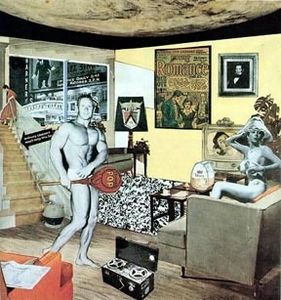
Richard Hamilton, Picasso's Meninas. 1973:
This British artist of the Pop Art movement was a primary printmaker, and in 1973 he executed a impress of one of Picasso'south variations on Velázquez's Las Meninas. With this print, Hamilton entered new artistic footing: a copy of a re-create.
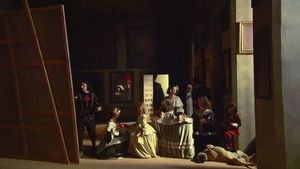
Eve Sussman, 89 Seconds at Alcázar. February xviii-May 22, 2005:
Sussman'southward work is a high-definition video tableau performed in 2005, intended to capture the moments immediately earlier and immediately subsequently the approximately 89 seconds for which all the protagonists of Velázquez's Las Meninas would have come into the precise configuration shown in the painting.
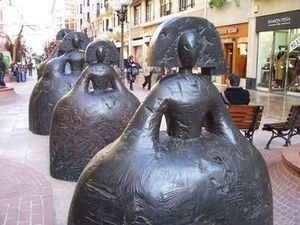
Manolo Valdés, Las Meninas. 2007:
Manolo Valdés is the next in a long line of Spaniards to take up the theme of Velázquez's Las Meninas. This series of twenty-one bronze statues representing the maids of award in Velázquez'south painting has graced the streets of Paris, France, Helsinki, Republic of finland, and New York City.
-
Adoration of the Magi
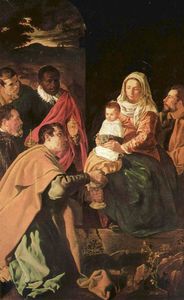
When Velázquez offset entered courtroom, the established painters scoffed at the unproven immature talent, calling him only good for mediocre portraits and defective the telescopic for subjects of greater weight. Velázquez proved the naysayers wrong, works like Las Meninas, which is among the most exquisite in the history of art.
Velázquez has not ceased to be a remarkably fecund source of inspiration for art critics and fine art historians up until the present twenty-four hours, nor has his reputation as one of the greatest painters of all fourth dimension been dimmed.
Velázquez paved the way for early on nineteenth century realist and impressionist painters, peculiarly Édouard Manet. Since and so, he has gone on to influence artists as diverse as Pablo Picasso, Salvador Dalí, and Anglo-Irish painter Francis Bacon. Such artists take demonstrated their honey for the works of Velázquez past recreating some of his about noted paintings.
Diego Velázquez was hailed a father of the Spanish school of art and is one of the greatest artists that ever lived.
-
Baroque
-
The Dwarf Sebastian de Morra
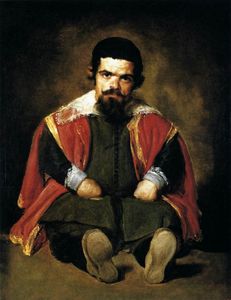
Diego Rodriguez de Silva y Velázquez was built-in into a society of paradox: Kingdom of spain was simultaneously undergoing ane of the nearly dramatic economical and political declines of any nation in European history, and unprecedentedly fertile, creative bursts of artistic activity.
In Velázquez's hometown of Seville in detail, circles of Humanist learning, arts and letters and philosophy all flourished, constituting a particularly fecund surroundings for a young artist.
On the other hand, Velázquez'southward chosen profession would become a significant obstacle in the artist's personal agenda. Spanish society was obsessed with nobility, and unlike in Italy, the visual arts were emphatically not equated with noble pursuits like literature or philosophy. Artists were seen every bit substantially vulgar craftsman who worked for a living with their hands, just similar blacksmiths or tailors.
Making matters even more complicated, the Catholic church exercised almost total power over the arts in Spain, dictating everything from subject area to limerick, meaning that artists had very little room to experiment or grow. Velázquez was thus fated to struggle from the very incipience of his career.
While nigh artists of the Bizarre period suffered from a serious drop in disquisitional opinion during the 18th century, somewhen fading into oblivion until existence rediscovered in the 1950s, Velázquez took an alternate route.
Considering of Spain'south political situation, the nation was more or less isolated from the residual of Europe during the heights of Neoclassicism, meaning that Velázquez's reputation was safe from the hands of Baroque-haters similar Wincklemann, who managed to destroy the reputation of such artists as Caravaggio, Carracci and Bernini.
By the fourth dimension Spain opened up to the residual of Europe in the offset of the 19th century, the world was gear up for Velázquez, and critics and artists alike oasis't ceased singing the master painter's praises.
The following list offers some of the best sources of further reading on Velázquez and his works.
• Dark-brown, Dale. The World of Velázquez: 1599-1660. Fourth dimension-Life Books, 1969
• Brown, Jonathan. Velázquez, Painter and Courtier. Yale University Press, 1986
• Carr, Dawson, et al. Velázquez. Yale University Press, 2006
• Davies, David, et al. Velázquez in Seville. National Galleries of Scotland, 1996
• Harris, Enriqueta. Velázquez. Phaidon, 1982
• Kahr, Madlyn Millner. Velázquez: the art of painting. Harper and Row, 1976
• López-Rey, José. Velázquez: A catalogue raisonné of his œuvre Faber and Faber, 1963.
• Pérez Sánchez, Alfonso, et al. Velázquez. The Metropolitan Museum of Art, 1989
• Wolf, Norbert. Diego Velázquez, 1599-1660: the face up of Spain. Taschen, 1998
• Wind, Barry. Velázquez's Bodegones: A report in 17th century Spanish genre painting. Fairfax: George Mason University Press, 1987
Source: https://www.artble.com/artists/diego_velazquez/paintings/las_meninas
0 Response to "Las Meninas by Is an Example of Baroque Art in Spain"
Publicar un comentario